
TL;DR:
- A cannabis business’s digital footprint includes online activity, reviews, and technical data that impact visibility and compliance.
- Proper management of digital footprint is crucial as organic channels are primary due to restrictions on paid advertising.
- Regular audits and proactive updates help minimize risks, improve reputation, and maintain regulatory compliance.
Most people think digital footprints are an individual concern, something to worry about when you’re searching sensitive topics online or posting on social media. But for cannabis business owners and marketers, your brand’s digital footprint is the difference between being found by new customers and being invisible, or worse, flagged by regulators. Every review, social post, website interaction, and ad trace your business leaves online forms a permanent record that shapes how customers, search engines, and compliance bodies see you. This guide breaks down exactly what a digital footprint is, why it carries unusually high stakes in cannabis, and how to manage it strategically.
| Point | Details |
|---|---|
| Digital footprint defined | Your digital footprint is every trace your cannabis business leaves online, from websites to reviews. |
| Organic presence matters | SEO and authentic online visibility drive most new customers in the highly regulated cannabis market. |
| Ongoing audits are crucial | Regularly checking and updating your footprint prevents risks and unlocks growth opportunities. |
| Management over deletion | It’s impossible to fully erase your digital trail, so focus on ongoing, proactive management. |
To understand how to strategically manage your online presence, it’s crucial to grasp exactly what forms your business’s digital footprint.
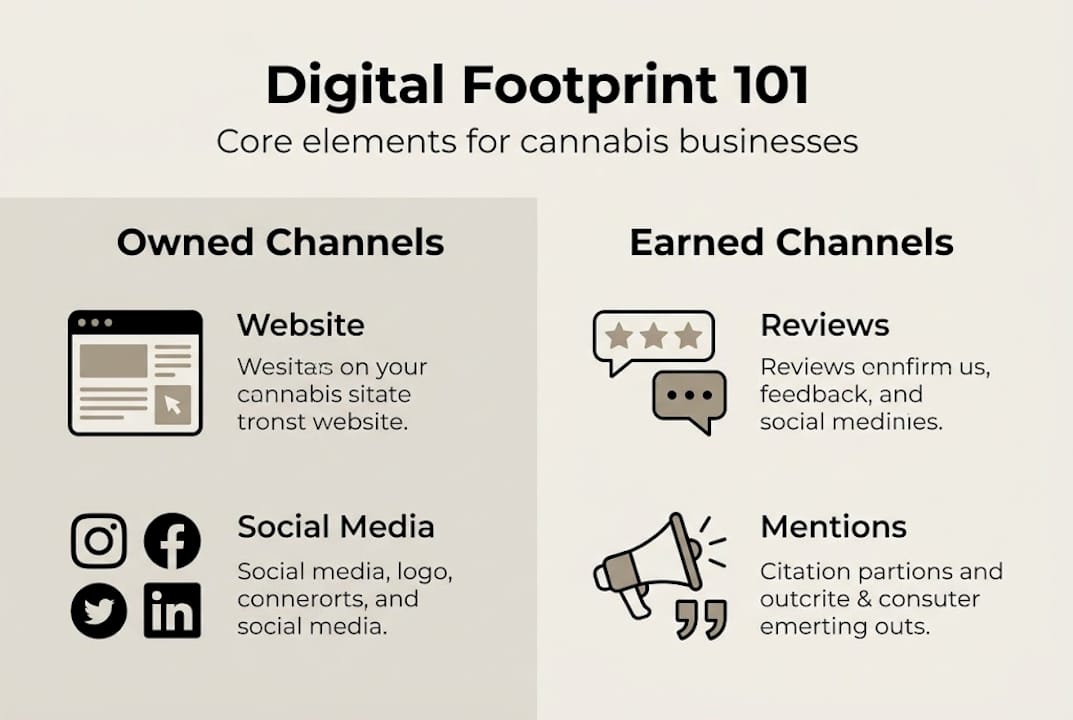
At its core, a digital footprint is the record of online activity including websites visited, social media posts, purchases, browsing history, cookies, IP addresses, and location data. For a cannabis business, this record is created every single day, whether you’re actively managing it or not. Every time a customer checks your Google Business Profile, tags your dispensary in a photo, or leaves a review, a data point is added to your brand’s digital trail.
Think of it in four distinct layers:
| Footprint Type | Examples for Cannabis Businesses | Management Level |
|---|---|---|
| Owned | Your website, social media pages, Google Business Profile | High |
| Earned | Customer reviews, news mentions, user-generated content | Medium |
| Paid | Ad metadata, sponsored post records, retargeting cookies | Medium |
| Technical | IP logs, cookies, server-side tracking, analytics data | Low |
Owned footprints are the most controllable. Your website content, product descriptions, and official social profiles all fall under this category. These are the assets you can optimize, update, and align with compliance requirements through solid cannabis marketing basics.
Earned footprints are trickier. When a customer posts about your dispensary, when a local blogger writes a review, or when a media outlet covers your brand, they add to your digital trail without your direct input. These mentions live on third-party platforms, and while you can influence them, you can’t fully control them.
Paid footprints often get overlooked. Even when your paid ad campaigns are paused or removed, the metadata and audience data associated with them persist in platform databases. In cannabis, where advertising restrictions are strict, even deleted ad attempts can leave traces.
Technical footprints are the least visible but can carry compliance risks. IP address logs, cookie data, and analytics tracking can reveal operational details about your business that you may not intend to share publicly.
Industry reality check: Many cannabis operators assume their footprint only matters if they’re actively posting online. In practice, digital footprints in business are built passively and continuously, making ongoing awareness a core business function, not an afterthought.
Common misconceptions lead to ignored or unmanaged footprints. Some operators believe that staying off social media reduces their digital exposure. The truth is the opposite. Unmanaged footprints filled with outdated information, unresponded-to reviews, and inconsistent business details do more damage than a proactively built presence ever could.
Now that you know what a digital footprint is, let’s explore why it’s especially high stakes for cannabis businesses.
Cannabit operators face a situation most industries don’t. Paid digital advertising on major platforms like Google and Meta is heavily restricted for cannabis-related products and services. You can’t simply spend your way to visibility. That forces your entire growth engine to rely on organic channels, making your managed digital footprint your single most valuable marketing asset.
The numbers back this up. According to industry research, 70% of cannabis marketers prioritize SEO over paid ads, and digital marketing drives 60% of new dispensary customers. When paid channels are mostly closed, your organic presence is not a supplement to your strategy. It is the strategy.
Here’s what an unmanaged footprint actually costs you:
These risks are not hypothetical. Dispensaries have faced licensing complications tied to online content that was years old. A single poorly worded product claim from an old blog post can become a serious issue during a license renewal.
Pro Tip: Building your digital footprint around digital marketing ethics is not just about staying compliant. It positions your brand as trustworthy at a time when consumer skepticism in cannabis is still high. Transparency in your online presence is a competitive advantage, not a limitation. Review your compliance best practices regularly to stay ahead of platform and regulatory changes.
Proactive management transforms your footprint from a liability into a growth tool. Well-optimized local listings, consistent reviews, clear and compliant website content, and a strong earned media presence together build the kind of trust that converts browsers into loyal customers.
Seeing the stakes, let’s turn to actionable steps for cannabis businesses to audit and improve their digital footprints.
The foundation of managing your footprint is a structured audit. Research confirms that businesses map digital footprints by auditing websites, social profiles, and reviews, using methodologies that include regular scans, SEO optimization, social listening, and employee training. Here’s a practical process you can start today:
Inventory your owned assets. List every platform where your business has an official presence. Include your website, Google Business Profile, Yelp, Weedmaps, Leafly, Instagram, Facebook, LinkedIn, and any cannabis-specific directories. Check for outdated logos, old addresses, and inconsistent business descriptions.
Search your business from a customer’s perspective. Open an incognito browser and search your dispensary name, address, and top product categories. Note what appears on the first two pages of results. This is your current footprint as new customers see it.
Monitor brand mentions. Set up Google Alerts for your business name and key product lines. Use social listening tools like Mention or Brand24 to track conversations across platforms. Unanswered mentions represent missed engagement opportunities.
Scan for technical risks. Review your website’s cookie consent processes, check your analytics setup for data accuracy, and confirm your site’s privacy policy reflects how you actually collect visitor data.
Audit your review landscape. Count and categorize your reviews across all platforms. Note star ratings, common themes in negative feedback, and gaps in your response rate. Reviews you haven’t responded to are part of your footprint and send a signal to potential customers.
| Audit Method | Best For | Time Required |
|---|---|---|
| Manual review | Small businesses, initial setup | 3 to 5 hours |
| Automated tools (Mention, Semrush) | Ongoing monitoring | 1 to 2 hours/month |
| Professional audit services | Complex or multi-location businesses | Varies by scope |
Once you’ve mapped your footprint, prioritize fixes in this order: compliance issues first, then reputation management, then SEO and marketing optimization. Addressing a non-compliant product claim on your website is more urgent than optimizing a meta description.

For social platforms, understanding shadowban prevention is critical because your content strategy directly shapes the technical footprint those platforms build around your account. Review social media monitoring methods with reliable social media monitoring tips to strengthen your approach. Also make sure you’re not falling into common traps by learning to avoid digital marketing pitfalls that can set back months of progress.
Pro Tip: Set a recurring quarterly calendar reminder specifically for digital footprint audits. A one-time audit gets you oriented. Quarterly reviews keep you ahead of new reviews, content changes, and platform algorithm updates. Ongoing vigilance always beats reactive cleanup.
Once auditing and action plans are in motion, cannabis businesses face the reality of digital permanence and how to navigate it.
Here’s the truth most guides skip over: you cannot fully delete a business’s digital footprint. Platforms cache data, third-party sites archive old pages, and search engines retain indexed content long after it’s removed from its original source. For cannabis operators, this permanence means that proactive management is always more effective than reactive removal.
That said, you can significantly minimize your exposure and shape your narrative. Here’s what actually works:
The digital record of your business in cannabis is also relevant in cannabis legal marketing contexts, especially if your brand has been through compliance reviews or licensing challenges. Knowing your historical footprint helps you address potential issues before they resurface.
The core principle: Proactive transparency beats suppression every time. Brands that try to hide legacy data or bury old content through aggressive removal often draw more attention to problems than those who address issues openly and build a strong, forward-looking presence.
For detailed frameworks that align with current standards, review comprehensive digital forensics best practices to understand how professionals assess and manage digital records in regulated industries.
Moving beyond standard advice, here’s a candid perspective on cannabis and digital footprint reality.
Most marketing consultants treat digital footprint management like a housekeeping task. Clean up old content, optimize your listings, respond to reviews. Done. What that approach misses is the structural reality that cannabis businesses face. You operate in an industry where public stigma, patchwork state and federal regulation, and platform-level censorship all actively work against you. Your digital footprint isn’t just a marketing metric. It’s evidence of how you operate.
Regulators, landlords, financial institutions, and potential partners all review your digital presence before making decisions. A disorganized or inconsistent footprint signals operational risk even if your actual compliance record is spotless. Research emphasizes that ongoing audits outperform one-time cleanup efforts and that organic traffic management produces compounding returns for firms operating in restricted verticals.
The businesses we see succeed long-term in cannabis are the ones that treat their footprint as a living data asset. They don’t ask “what can we delete?” They ask “what does our digital presence communicate, and is that message intentional?” That mindset shift is where CBD marketing strategies from the restricted industries space prove most instructive. Build your footprint with intention from day one, audit it regularly, and treat transparency as strategy.
For cannabis businesses ready to go from managing challenges to thriving online, here’s where to start.
Managing your digital footprint across every platform, review site, and technical layer is a lot to handle while also running a dispensary or cultivation operation. That’s where specialized expertise changes the game.
At Dope SEO, we build SEO strategy for cannabis businesses that accounts for your unique regulatory environment, platform restrictions, and competitive landscape. From compliance-forward content to fully optimized local listings, we help your footprint work for you, not against you. Our local search workflow process is built specifically for cannabis operators who need visibility without the compliance headaches. If you’re ready to build a footprint that attracts customers and earns trust, let’s talk.
No, you cannot fully erase all traces of your business online, but you can minimize exposure and actively shape your reputation through consistent, proactive management.
Start by listing all your public digital assets, verifying your social profiles, and running a Google search on your business name to see exactly what potential customers and regulators find. Solid footprint mapping methodology includes auditing websites, social profiles, and reviews as your baseline.
With paid ads heavily restricted, SEO is the primary visibility tool for cannabis brands, and 60% of new dispensary customers come directly from digital marketing channels.
Quarterly audits are the recommended standard, based on industry methodologies including regular scans that catch both emerging risks and new optimization opportunities before they become costly problems.
Yes. Ignoring reputation issues harms both your search visibility and compliance standing. Proactive reputation management consistently outperforms suppression attempts and keeps your brand positioned as credible and trustworthy.

© 2026 Curious Monkeys Pressing Buttons LLC DBA Cannabiz Marketing Solutions AKA DopeSEO. All rights reserved.