
TL;DR:
- A search engine penalty reduces a website’s search visibility through manual actions or automated demotions.
- Identifying the penalty type determines the recovery process; manual actions require removal of violations, while algorithmic demotions need quality improvements.
A search engine penalty is an enforcement action that reduces a website’s visibility in search results, either through a manual action applied by a human reviewer or an automated algorithmic demotion triggered by Google’s ranking systems. Both types reduce rankings and traffic, but they work differently and require different fixes. If your site suddenly loses organic visibility, understanding which type you’re dealing with is the first decision you need to make. Google Search Console, Google’s Panda and Penguin updates, and SpamBrain are the key names you need to know before anything else.
A search engine penalty is defined as any enforcement action that causes a site to rank lower or disappear from search results due to guideline violations or quality failures. Search Engine Land describes penalties as enforcement actions that lead to reduced visibility or full deindexing. The most recognizable form is a Google manual action, but algorithmic demotions are far more common and often go unnoticed for weeks.

The business impact is real. Penalties reduce visibility and constitute a direct business risk, not just a traffic inconvenience. A dispensary or e-commerce site that loses page-one rankings can see revenue drop sharply before the cause is even identified. That gap between the drop and the diagnosis is where most of the damage happens.
The standard industry term for what most people call a “Google penalty” is a manual action when applied by a human reviewer, and an algorithmic demotion when caused by an automated system update. Both fall under the broader category of search engine penalties. Using the right term matters because the recovery path for each is completely different.
The two types of search engine penalties are manual actions and algorithmic demotions. They share the same outcome (lower rankings) but differ in cause, visibility, and recovery method.
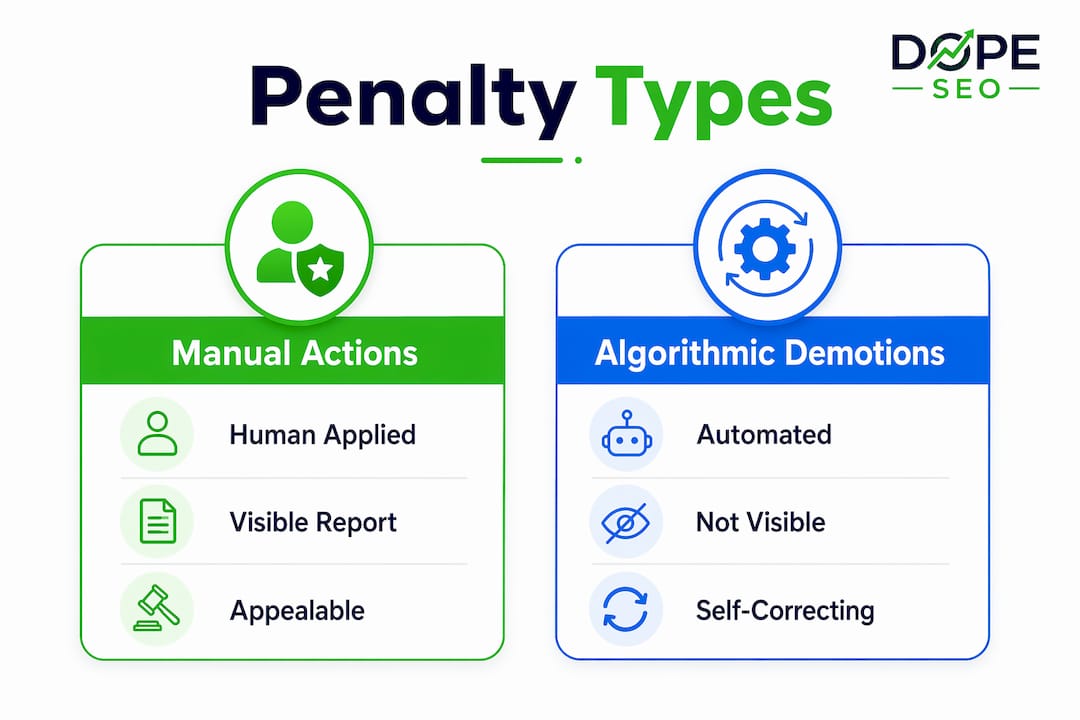
A manual action is applied by a Google employee who reviews a site and finds a violation of Google’s Search Essentials (formerly Webmaster Guidelines). Manual actions appear in the Manual Actions report inside Google Search Console, and Google typically sends a notification email when one is applied. Common triggers include spammy backlinks, thin content, cloaking, and user-generated spam.
An algorithmic demotion is an automated ranking impact caused by Google’s systems, not a human reviewer. Algorithmic penalties do not appear as manual actions in Search Console. They correlate with known algorithm updates like Panda (content quality), Penguin (link spam), and SpamBrain (AI-detected spam). You will not receive a notification. You have to diagnose the cause yourself.
| Feature | Manual action | Algorithmic demotion |
|---|---|---|
| Applied by | Human reviewer | Automated system |
| Visible in Search Console | Yes, under Manual Actions | No explicit notice |
| Notification email | Yes | No |
| Recovery method | Fix violations, submit reconsideration request | Fix quality issues, wait for re-crawl |
| Common triggers | Link spam, cloaking, thin content | Low-quality content, poor UX, bad links |
| Timeline to recover | Weeks to months after review | Weeks to months after next update |
Pro Tip: Check the Manual Actions report in Google Search Console first, every time. If it shows no issues, you are dealing with an algorithmic problem, not a manual one. That single check saves hours of misdirected effort.
Detection starts with Google Search Console. Open the Manual Actions report and check for any active notices. If a manual action exists, Google describes the violation and the affected pages. If the report is clean, the ranking drop has a different cause.
For algorithmic demotions, follow these steps:
Not every ranking drop is a penalty. Technical errors, server downtime, competitor improvements, and seasonal shifts all cause traffic losses that look identical to penalties in a chart. The timeline correlation with an update date is your strongest diagnostic signal.
Pro Tip: Set up email alerts in Google Search Console for manual action notifications. You will know within hours instead of discovering the problem weeks later during a traffic review.
Search engine penalties follow violations of Google’s Search Essentials. The causes split into two categories: deliberate black-hat tactics and unintentional quality failures.
Black-hat SEO tactics that trigger penalties:
Unintentional quality failures that trigger algorithmic demotions:
Cannabis and hemp businesses face an additional layer of risk. Platform restrictions and regulatory language can push site owners toward workarounds that inadvertently cross into cloaking or misleading content territory. Staying on the right side of SEO compliance guidelines is not optional in a regulated industry.
Recovery depends entirely on the penalty type. Mixing up the two workflows wastes time and delays results.
Algorithmic recovery requires triangulating the drop date with update timelines, then assessing content quality, backlink health, and user experience signals. There is no reconsideration request. You fix the quality issues and wait for Google to re-crawl and re-evaluate your site at the next update cycle.
Pro Tip: Do not make multiple simultaneous changes and then wait. Fix one category at a time where possible, so you can isolate what actually moved the needle when rankings shift.
Prevention is a governance process, not a one-time task. Sites that stay clean treat SEO compliance as an ongoing operation.
Understanding ethical digital marketing practices is the foundation of penalty prevention. Sites that build authority through genuine content quality and earned links do not need to worry about the next algorithm update.
A search engine penalty is an enforcement action that reduces rankings through either a manual action or an algorithmic demotion, and each type requires a completely different diagnosis and recovery process.
| Point | Details |
|---|---|
| Two distinct penalty types | Manual actions are human-applied and visible in Search Console; algorithmic demotions are automated and require self-diagnosis. |
| Search Console is your first stop | Check the Manual Actions report before assuming any ranking drop is a penalty. |
| Partial fixes fail | Manual action recovery requires removing entire violation categories, not just the most visible examples. |
| Algorithmic recovery takes time | Fix content quality, backlinks, and UX signals, then wait for the next update cycle to confirm improvement. |
| Prevention beats recovery | Quarterly audits, backlink monitoring, and editorial standards keep sites out of penalty territory. |
The most common mistake I see is treating every traffic drop as a penalty. A site loses 30% of its organic traffic and the owner immediately assumes Google penalized them. That assumption sends them down the wrong path for weeks.
Manual penalties show up clearly in Google Search Console. If the Manual Actions report is clean, you are not dealing with a manual penalty. Full stop. The problem is algorithmic, technical, or competitive. Diagnosing before acting is the only approach that works.
The second mistake is the partial fix. Site owners remove the most obvious spammy links or rewrite a handful of thin pages, then submit a reconsideration request expecting approval. Google’s reviewers look at the entire site. Thorough remediation is required for reconsideration approval, not a sample of improvements.
What I have found consistently is that sites with strong editorial standards and clean link profiles rarely face penalties in the first place. The businesses that get hit are usually the ones that took shortcuts at some point, often years earlier, and the bill finally came due after an algorithm update. Build clean from the start, audit regularly, and Search Console becomes a confirmation tool rather than a crisis alert.
— Max
Dealing with a search engine penalty is stressful, especially when organic traffic drives your revenue. Dopeseo specializes in SEO for regulated industries where the stakes of a ranking drop are higher than average.

Dopeseo’s team conducts full technical and content audits, analyzes backlink profiles for toxic links, and builds the documentation needed for Google reconsideration requests. For algorithmic demotions, Dopeseo identifies the update correlation, prioritizes quality fixes, and monitors recovery through Google Search Console. If you want a team that understands the specific compliance pressures facing cannabis and hemp businesses, explore Dopeseo’s cannabis SEO services or review the 2026 cannabis SEO strategy to see how proactive compliance protects your rankings long term.
A search engine penalty is an enforcement action by Google or another search engine that reduces a website’s rankings or removes it from search results entirely. Penalties take the form of manual actions (applied by human reviewers) or algorithmic demotions (triggered by automated systems).
Open Google Search Console and check the Manual Actions report. If a manual action exists, Google lists the violation type and affected pages. A clean report means the ranking drop is not a manual penalty.
Manual action recovery typically takes weeks to months after a reconsideration request is approved. Algorithmic recovery depends on when Google next runs the relevant update, which can also take weeks to months after quality fixes are implemented.
The most common causes include manipulative link building, keyword stuffing, cloaking, thin or duplicate content, and poor user experience signals. Negative SEO attacks from competitors can also trigger algorithmic demotions by flooding a site with toxic backlinks.
Consistent prevention is possible through quarterly SEO audits, monthly backlink monitoring, editorial standards for all site content, and staying current with Google Search Essentials. Sites that build authority through quality content and earned links face significantly lower penalty risk.

© 2026 Curious Monkeys Pressing Buttons LLC DBA Cannabiz Marketing Solutions AKA DopeSEO. All rights reserved.