
TL;DR:
- Cannabis SEO requires strict compliance to avoid penalties, deindexing, and legal issues.
- Both state and federal regulations influence cannabis website content, including disclaimers and geo-restrictions.
- Building trust through compliant, transparent content and strategic off-page efforts is key for long-term growth.
Most cannabis cultivators assume that solid keyword research and a few backlinks are enough to rank well. That assumption is costing businesses real money. The cannabis industry operates under a unique set of legal restrictions that make standard SEO tactics not just ineffective but potentially dangerous to your online presence. Compliance mistakes can lead to penalties, site takedowns, or lost search rankings, and for a cultivator investing in digital growth, that risk is too high to ignore. This guide walks you through the specific compliance challenges you face, the regulatory layers you must understand, and the practical SEO steps that keep your site visible, trusted, and legally sound.
| Point | Details |
|---|---|
| Compliance is non-negotiable | Cannabis cultivators must meet both state and federal rules for online content and marketing. |
| Specialized SEO strategies win | Success requires adapting SEO tactics to cannabis industry regulations, not just standard best practices. |
| On-page and off-page tactics differ | Both on-site content and local SEO need compliance filters different from most industries. |
| Regular updates matter | Keeping up with regulatory and policy changes prevents costly mistakes and lost visibility. |
Running a cannabis cultivation business means operating in one of the most scrutinized industries online. Search engines like Google apply stricter content policies to cannabis sites than to virtually any other industry. That means a page that looks perfectly optimized by general standards could still get flagged, penalized, or removed from search results entirely.
The risks are not theoretical. Here is what non-compliance can actually cost you:
The cannabis industry SEO challenges are distinct from those in mainstream markets. You cannot simply follow what a general SEO agency recommends, because those recommendations were built for industries without your restrictions.
What makes cannabis SEO different? Three things stand out. First, keyword selection is not just a traffic decision. Certain terms related to medical claims or recreational use may violate platform policies or state law. Second, your site architecture must support compliance features like age verification gates and geographic content restrictions. Third, your link profile needs to come from credible, compliant sources, not gray-market directories that could associate your domain with policy-violating content.
Statistic to know: According to industry tracking data, cannabis websites that lack basic compliance features are significantly more likely to face search engine penalties than those with structured compliance frameworks in place.
Following the right compliance steps for cannabis sites from the start is far less expensive than recovering from a penalty after the fact.
Pro Tip: Set a quarterly calendar reminder to review both your state’s cannabis advertising regulations and any updates to Google’s content policies. Regulations shift faster in this industry than in almost any other.
One of the most confusing aspects of cannabis SEO is that you are always operating under two sets of rules at the same time. Federal law still classifies cannabis as a controlled substance, while many states have legalized it for medical or recreational use. Your website content must satisfy both layers, and they do not always agree.
Cannabis websites must comply with both state and federal restrictions that affect content and structure. That means your meta descriptions, page copy, image alt text, and even your URL slugs can all become compliance issues if you are not careful.

Here is a breakdown of what each layer typically requires:
| Requirement | State level | Federal level |
|---|---|---|
| Age verification gate | Required in most legal states | Required to avoid FTC scrutiny |
| Medical claims | Strictly regulated per state law | Prohibited under FDA guidelines |
| Disclaimers | State-specific language required | General health disclaimers advised |
| Restricted keywords | Varies by state advertising rules | Broad restrictions on health claims |
| Geographic content blocks | Required for interstate compliance | Advised to limit federal exposure |
After recent state policy shifts in several markets, cultivators who had not updated their site content faced sudden compliance reviews. States like California and Colorado have tightened their digital advertising rules, requiring more explicit disclaimers and restricting certain promotional language that was previously tolerated.
Features that support compliance at both levels include:
“Transparency in cannabis SEO is not just a legal requirement. It is a trust signal that search engines and customers both reward.”
Building your site with compliant cannabis web design principles from day one is far easier than retrofitting compliance onto an existing site. And if you are still building your foundational knowledge, reviewing cannabis SEO fundamentals will give you a strong starting point.
Once you understand the regulatory landscape, you can start applying it directly to your on-page SEO. On-page optimization must integrate compliant language and avoid restricted claims, which means every element of your page, from the H1 tag to the footer disclaimer, needs to be reviewed through both an SEO and a compliance lens.
Here is a step-by-step approach to structuring compliant on-page content:
Common content violations that cultivators make include using terms like “heals,” “cures,” or “treats” in product descriptions, and making potency claims without proper regulatory context. These are easy mistakes to miss when you are focused on ranking.
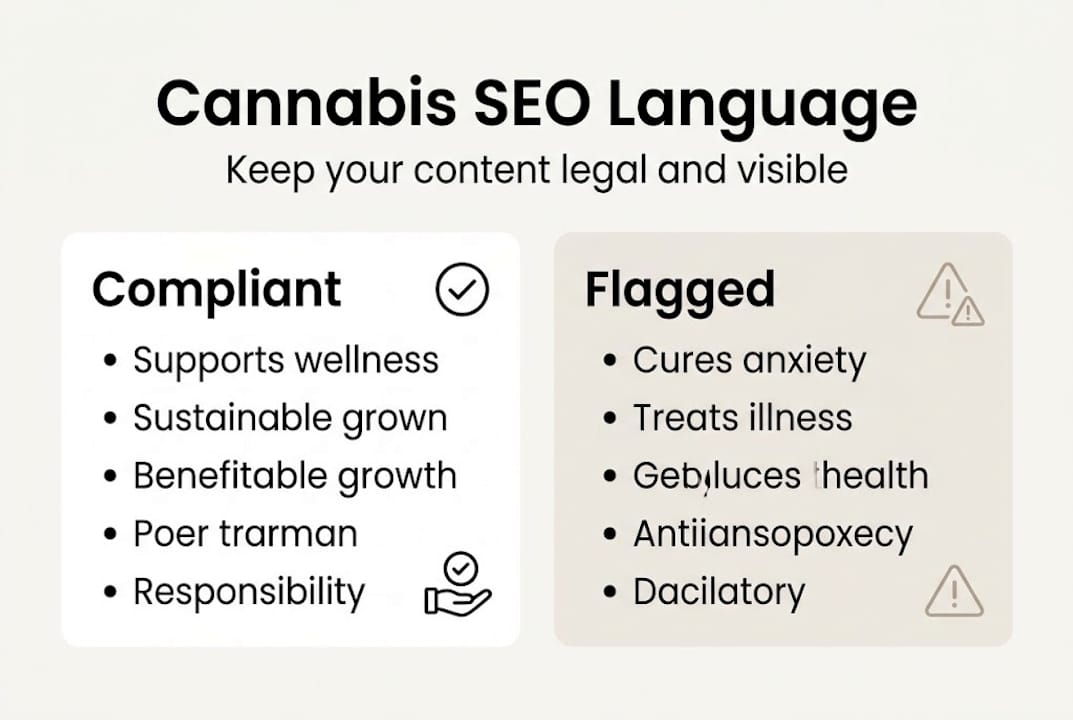
Here is a quick reference for terminology:
| Allowed language | Flagged language |
|---|---|
| “May support relaxation” | “Cures anxiety” |
| “Grown using sustainable practices” | “Medically proven benefits” |
| “High-quality flower” | “Best medicine available” |
| “Lab-tested cannabinoid profile” | “Guaranteed health results” |
Understanding the importance of SEO for brands in this space means recognizing that compliant content is not a limitation. It is a quality signal that builds long-term authority.
Pro Tip: Before publishing any new page, run it through a compliance checklist that covers H1 language, meta content, image alt text, disclaimers, and internal linking. A 10-minute review can prevent weeks of recovery work.
Off-page SEO for cannabis cultivators requires a different mindset than what works in other industries. Local SEO for cultivators is key for discovery, but must follow strict online advertising guidelines that vary by state and platform.
Link building is where many cultivators unknowingly create compliance problems. Getting a backlink from a site that promotes illegal activity or makes unapproved health claims can associate your domain with that content in the eyes of search engines. Quality matters far more than quantity here.
Off-page actions that are always compliant include:
Social media is a powerful off-page tool, but it comes with real risk. Instagram and Facebook restrict cannabis content, so you need a clear content policy before posting. Focus on educational content about cultivation practices, sustainability, and industry news rather than direct product promotion. This approach keeps you visible without triggering platform restrictions.
For local search, your Google Business Profile functions as a digital storefront. Keep it fully updated, respond to reviews professionally, and use your business description to communicate what you grow and where you operate without making restricted claims.
Pro Tip: Build relationships with compliant, industry-recognized directories rather than gray-market listing sites. One strong listing on a credible platform does more for your local SEO than ten listings on sites with questionable compliance records.
For a broader view of how these tactics fit together, exploring digital strategies for cannabis companies gives you a useful framework for prioritizing your efforts.
Here is what we see consistently working with cultivators across legal markets: most treat SEO compliance as a checklist, not a strategy. They add an age gate, drop in a disclaimer, and consider the job done. Then they wonder why their rankings plateau.
The cultivators who actually grow their organic traffic treat compliance as part of their brand story. They publish content about their sustainable growing practices, their testing standards, and their commitment to transparency. That content earns trust from readers and authority signals from search engines simultaneously.
Compliance is not the ceiling. It is the floor. The brands that build above it, by creating genuinely useful, honest, and well-structured content, are the ones that dominate search results over time. A working SEO compliance strategy is not about avoiding penalties. It is about building a digital presence that compounds in value year after year.
The cultivators who think long-term about their content and their compliance are the ones we see outranking competitors who spend twice as much on ads.
Understanding compliance is one thing. Executing it consistently across a growing website while keeping up with regulatory changes is another challenge entirely. That is where having an experienced partner makes a real difference.
At Dope SEO, we specialize in helping cannabis cultivators build visibility the right way, with strategies built around your specific regulatory environment. From compliant content creation to local SEO and technical audits, our cannabis SEO best practices are designed to grow your rankings without putting your business at risk. If you are ready to stop guessing and start growing, explore what Dope SEO solutions can do for your cultivation brand.
Key risks include missing age gates, making unapproved medical claims, and lacking state-mandated disclaimers. Missing compliance features exposes cultivators to both legal penalties and search engine deindexing.
Both Google and Bing enforce content restrictions on the cannabis industry, so pages that violate their policies may be removed from results. Major search engines apply strict content policies that go beyond standard webmaster guidelines for cannabis sites.
Cultivators can use compliant directory listings, Google Business Profiles, and reputation building for discoverability. Local SEO is key for cultivator visibility when direct advertising channels are restricted.
Start with a thorough compliance audit to identify gaps and quick-win fixes on your current website. An audit identifies SEO compliance gaps so you can prioritize the changes that reduce risk and improve rankings fastest.

© 2026 Curious Monkeys Pressing Buttons LLC DBA Cannabiz Marketing Solutions AKA DopeSEO. All rights reserved.