
TL;DR:
- Effective hemp marketing relies on organic channels like SEO, content, and influencer partnerships.
- Consistent, compliant education-first content and local SEO are key to long-term growth.
- Ongoing monitoring, testing, and system updates are essential to sustain successful results.
Promoting hemp products online sounds straightforward until you try running your first ad campaign and watch it get rejected within hours. The reality is that hemp marketing operates in a uniquely restricted environment where major advertising platforms either ban hemp outright or impose conditions so narrow that most traditional paid strategies are simply off the table. That means the playbook used to promote electronics, clothing, or even supplements won’t carry you far. What works for hemp brands is a specialized, compliance-first approach built on organic reach, educational content, and multi-channel strategy. This guide breaks down exactly how that works and what it takes to see real results.
| Point | Details |
|---|---|
| Hemp marketing basics | Hemp marketing requires unique, compliant approaches different from traditional or even cannabis marketing. |
| Omnichannel strategy works best | Combining SEO, quality content, email/SMS, and influencers maximizes reach in a restricted landscape. |
| Education over sales | Focusing on valuable, educational content is essential for both compliance and building trust online. |
| Measure and adapt | Use trackable tools to monitor results and continually adjust your marketing as the rules change. |
Now that we’ve addressed why standard marketing approaches fall short, let’s clarify exactly what differentiates hemp marketing from the rest.
Hemp marketing refers to the digital promotion of legal hemp-derived products, including CBD oils, tinctures, topicals, edibles, and wellness goods, through online channels. While hemp was federally legalized under the 2018 Farm Bill, marketing it remains anything but simple. Social platforms, search ad networks, and payment processors still treat hemp with heavy scrutiny, and many apply outright bans on promotional content regardless of a product’s legal status.
This means that the aggressive, conversion-focused ad strategies that work in other industries create immediate risk for hemp brands. A single policy violation on Facebook or Google can result in a disabled account or a permanent ban. That’s not a recoverable situation for most businesses.
Instead, effective hemp marketing leans hard into channels where brands control the narrative. Educational content marketing is one of the most reliable ways to build organic reach, trust, and search visibility without triggering platform restrictions. Rather than running ads that scream “buy now,” successful brands create guides, FAQs, and wellness content that genuinely helps their audience understand hemp products.
As one industry overview puts it:
“Core mechanics include SEO, content marketing, email/SMS, and influencer partnerships, focusing on education over direct sales to avoid bans.”
The four primary channels that drive compliant hemp marketing are:
Each channel has its own compliance nuances, but together they form a foundation that compounds over time and carries far less platform risk than paid advertising.
With the definition in place, let’s examine what it actually takes to build a strong, compliant hemp marketing foundation in 2026.
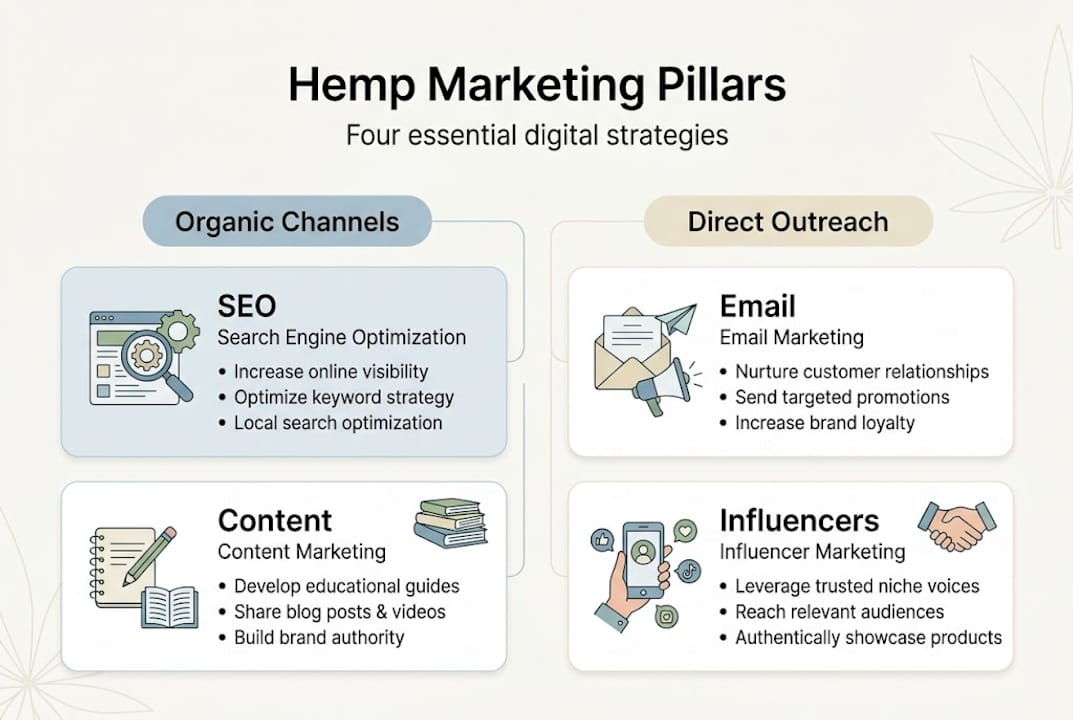
Search engine optimization is the single most powerful long-term channel available to hemp brands. When someone types “best CBD oil for sleep” or “hemp gummies near me” into Google, they have intent. They want information or they want to buy. Ranking for those searches means capturing an audience that is already looking for what you offer.
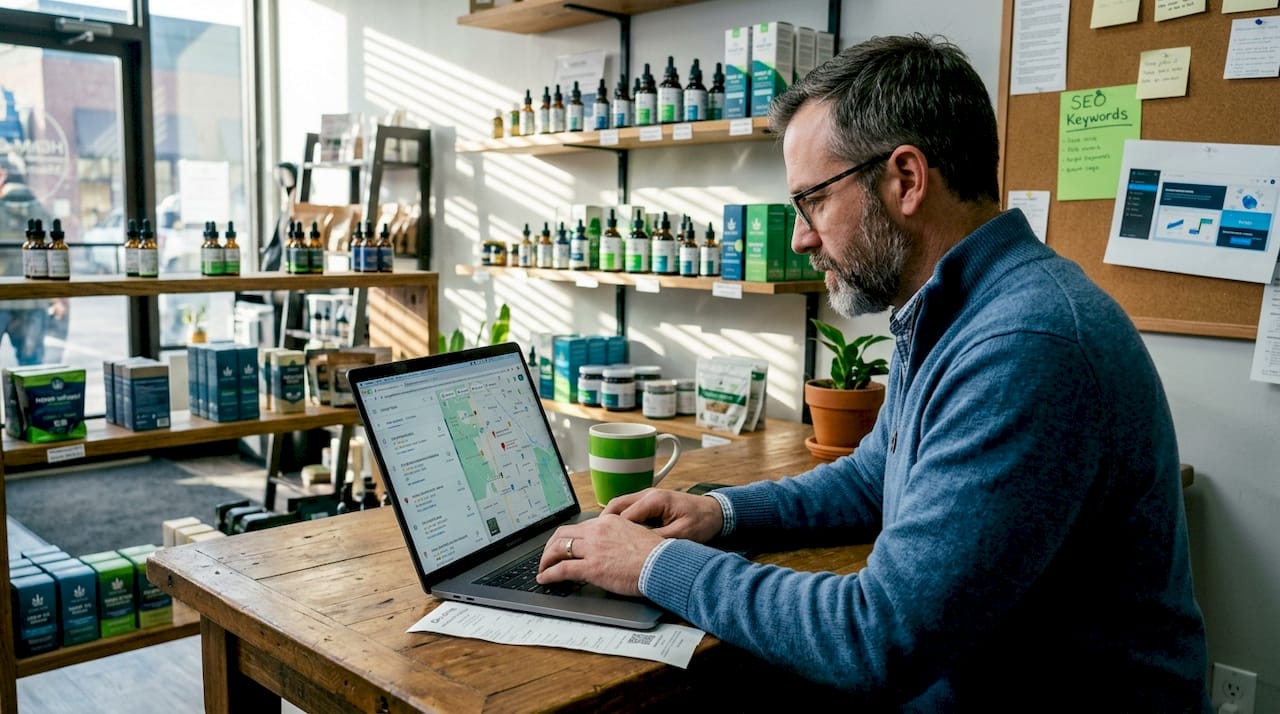
Local SEO for cannabis is especially important if you operate a retail presence or serve a specific geographic area. Optimizing your Google Business Profile, building local citations, and earning reviews all contribute to map pack visibility that drives foot traffic and local phone inquiries. Technical SEO matters too. Site speed, crawlability, mobile responsiveness, and structured data all signal to Google that your site is a reliable source worth surfacing.
Content is the vehicle that SEO rides in on. Without valuable, well-researched content, your keyword rankings will be shallow and your audience engagement will be low. Hemp brands that win consistently publish content that answers real questions: What is the difference between full-spectrum and broad-spectrum CBD? Is hemp legal in all 50 states? How do I read a certificate of analysis?
A well-structured content strategy for hemp brands organizes topics into clusters, where one authoritative pillar page links to several supporting articles. This structure signals topical authority to search engines and keeps visitors on your site longer, both of which improve your rankings and your conversion rates.
Your email and SMS list is the only audience you truly own. Social media accounts can be suspended. Search rankings can shift. But a well-nurtured subscriber list belongs to you and allows direct communication that no algorithm can interrupt. The key to compliance here is permission. Every subscriber must have explicitly opted in, and every message must follow CAN-SPAM or TCPA guidelines.
Use this channel to share educational resources, announce new products, and deliver value-first content that keeps your brand top of mind without being promotional to the point of triggering complaints.
Hemp-friendly influencers, particularly those in wellness, fitness, or lifestyle niches, can introduce your products to engaged audiences without the compliance risk of running paid ads yourself. The key is choosing creators who understand the space, disclose their partnerships properly, and focus on storytelling rather than hard selling.
Here’s a quick comparison of what’s generally permitted versus what typically creates problems:
| Marketing action | Permitted | Risky or prohibited |
|---|---|---|
| Blog content about hemp benefits | Yes | No |
| Facebook paid ads for CBD products | No | Yes |
| Google PPC for hemp oil | Limited | Often restricted |
| Email newsletter to opt-in list | Yes | No |
| Influencer storytelling posts | Yes (with disclosure) | Without disclosure |
| Health claims (e.g., “cures anxiety”) | No | Yes |
| Local SEO and Google Business Profile | Yes | No |
To get started with an omnichannel hemp marketing plan, follow these steps:
As best practice data confirms, an omnichannel approach combining SEO, content clusters, and email/SMS yields compounding ROI that’s measurable through QR code and coupon tracking.
Pro Tip: Assign a unique QR code to each traffic source (email, influencer, in-store) to clearly attribute which channel is driving conversions. This gives you real data to optimize your mix without relying on assumptions.
To bring these strategies to life, let’s look at actual data from a brand that’s turned compliance into rapid growth.
Wild Orchard Hemp ran a lead generation campaign that produced results few hemp brands thought achievable through organic and content-first methods. According to the campaign’s documented results, the brand generated 24,000 new customer profiles in just 3.5 months, turning a $3,500 investment into $13,700 in revenue, representing a 292% return on investment.
Let that sink in. A $3,500 spend. Nearly $14,000 back. In 3.5 months.
Here’s how the metrics broke down:
| Campaign metric | Result |
|---|---|
| New customer profiles generated | 24,000 |
| Campaign spend | $3,500 |
| Revenue attributed | $13,700 |
| Return on investment | 292% |
| Campaign duration | 3.5 months |
The strategies behind these numbers weren’t complicated. They were just executed well. Wild Orchard Hemp used:
The key lesson here is that none of these tactics required paid ads on restricted platforms. They relied entirely on permission-based channels and value-first content. The ROI speaks to how effective that approach can be when executed with intention and consistency.
What other hemp brands can take from this example:
While proven strategies exist, many marketers still fall into avoidable traps. Here’s how you can steer clear of those pitfalls.
Even with the right tools and intent, hemp marketing campaigns regularly stumble because of predictable, preventable mistakes. Here are the five most common pitfalls and how to avoid them:
Pitfall 1: Direct product pitches on restricted platforms. Posting content that reads like an advertisement, “Buy our CBD oil today for 20% off,” flags your account and risks suspension. Replace hard-sell language with educational framing that builds curiosity rather than demanding a purchase.
Pitfall 2: Ignoring compliance updates. Platform policies for hemp change frequently. A tactic that worked in January may violate updated guidelines by March. Assign someone on your team to monitor changes from Google, Meta, and the FTC at least quarterly. When in doubt, get a legal review before publishing.
Pitfall 3: Neglecting local SEO. If you sell at retail or serve a regional market, ignoring local search optimization means leaving a large, high-intent audience on the table. Claiming and optimizing your Google Business Profile, earning consistent reviews, and building local citations all directly impact how visible you are to nearby customers who are ready to buy.
Pitfall 4: Poor attribution. Running campaigns without tracking mechanisms is like driving without a dashboard. You have no idea what’s working. Use UTM parameters, unique landing pages, and coupon codes for every campaign so you can connect revenue back to specific efforts.
Pitfall 5: Not tracking ROI. Even brands that track traffic often fail to connect it to revenue. Set up goal tracking in Google Analytics or your eCommerce platform so every key action, from email signup to purchase, is measurable and reportable.
Building visibility with compliant content requires discipline. Every piece of content, every email, every influencer brief should be evaluated for both effectiveness and regulatory risk before it goes live.
Pro Tip: Always prioritize educational content over direct sales messaging, especially on social platforms. Framing your content as “here’s what you should know about hemp” rather than “here’s why you should buy our hemp product” keeps you on the right side of platform policies while still building brand authority.
Legal review should not be a one-time event at launch. As your product line grows and as state-level regulations continue to evolve, what you can legally say about your products will change. Schedule a compliance review every six months at minimum and treat it as a standard business operation, not an optional expense.
Here’s the part that separates brands that sustain growth from those that plateau after their first good month: hemp marketing is not a project you complete. It’s a practice you maintain.
Many brands invest heavily in a launch campaign, see initial results, and then shift their attention elsewhere. The content stops being updated. The email list goes cold. The SEO strategy stagnates. Within six months, rankings slip, engagement drops, and the momentum built from that initial investment quietly fades.
The hemp industry moves fast. Google’s algorithm updates constantly. Platform ad policies shift without warning. Consumer search behavior evolves as awareness grows and new product categories emerge. What drives traffic and conversions in March may be functionally obsolete by June. That’s not a worst-case scenario. That’s the normal operating environment for hemp marketers.
The brands that consistently outperform the competition are the ones building systems for adaptation. They review performance data monthly, not quarterly. They test new content angles and email subject lines continuously. They monitor compliance changes as soon as they’re announced. And they treat their SEO strategy as a living document, regularly refining content performance rather than setting targets once and hoping the results hold.
One-time efforts, even excellent ones, produce temporary results. Sustained, nimble strategy produces durable growth. The Wild Orchard Hemp example works not just because the campaign tactics were smart, but because those tactics existed within a broader, ongoing marketing commitment.
We’ve seen brands come to us frustrated that a strategy “stopped working,” only to discover they hadn’t touched their content, reviewed their local SEO, or refined their email flow in over a year. The strategy didn’t fail. The maintenance did. Don’t let that be your story.
Ready to move from theory to practice? Here’s how you can apply these insights with confidence.
Building a compliant, high-performing hemp marketing operation requires more than reading a guide. It requires execution, testing, and the kind of industry-specific knowledge that only comes from working in this space day after day.
At Dope SEO, we work exclusively with hemp, cannabis, and related businesses navigating exactly the challenges this article covers. From building an SEO strategy for cannabis brands that compounds over time, to developing content that earns rankings and trust, we know what works in this industry because we’ve built it for brands just like yours. If you want to skip the costly trial-and-error phase and start building with proven SEO strategies for dispensaries and hemp brands, connect with our team to explore what’s possible for your business.
Hemp marketing focuses on federally legal hemp products and generally faces fewer restrictions than cannabis or CBD marketing, but it still operates under strict platform policies and compliance frameworks that require careful, education-first strategy.
The safest path is educational content, organic SEO, and compliant email/SMS, because these channels avoid the direct sales pitches that trigger platform bans, as confirmed by cannabis marketing research.
Use unique QR codes, promo coupons, and lead magnets to track conversions and attribute revenue to specific campaigns, which is the same tracking method recommended for omnichannel hemp marketing plans.
Wild Orchard Hemp generated 24k leads and 292% ROI on a $3,500 campaign over 3.5 months by using gated content, incentivized signups, and cross-channel promotion without relying on restricted paid advertising.

© 2026 Curious Monkeys Pressing Buttons LLC DBA Cannabiz Marketing Solutions AKA DopeSEO. All rights reserved.